
Use our search function to quickly find the content you are looking for:
Product Development Today, companies face clear pressure: they must design faster, manufacture more precisely, reliably manage variants, and all the while keep their data consistent across departments, locations, and systems. This is precisely where Siemens NX becomes more than just a CAD or CAM system for many companies. Current publicly available Siemens references show that the real benefits arise where design, manufacturing, simulation, and PLM are integrated into a robust digital process. Siemens describes NX applications at companies including D’Andrea, Renishaw, ANAND CY Myutec Automotive, CargoKite, CycloTech, Arkadia Space, and MTU Aero Engines.
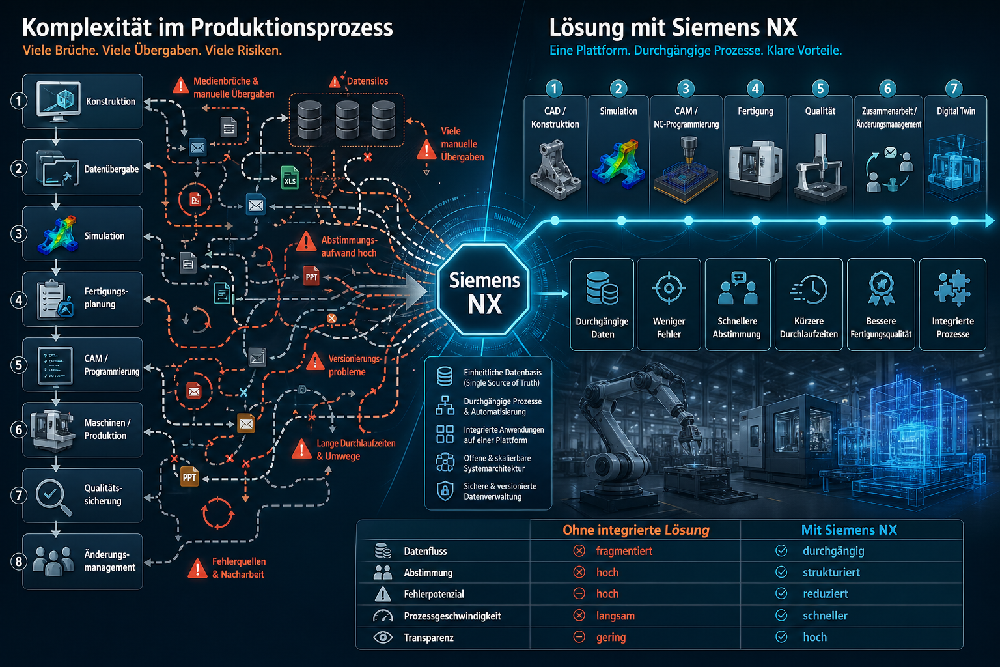
When people talk about Siemens NX, they're not just talking about modeling, NC programming, or simulation. Instead, the practical examples show a common denominator: Companies seek seamless workflows. You want fewer media breaks, fewer manual transfers, and less coordination effort between engineering, production planning, manufacturing, quality assurance, and suppliers.
D'Andrea, a manufacturer in the field Precision tools, shows this connection particularly clearly. According to Siemens, the company was able to [use] NX and Teamcenter reduce the development time from eight to two hours, reduce programming time by 50 percent and accelerate time-to-market by a factor of three. What is crucial here is not just pure CAM functionality. Added value arises from simulation, digital process assurance, and the ability to check manufacturing steps before the actual machine run.
Another example is Renishaw. The company faces a challenge that many Manufacturing plants familiar: increasing part variety, high precision requirements, and at the same time fewer available CNC experts. Siemens describes that Renishaw with NX CAM uses standardized process templates to improve quality and efficiency in manufacturing. According to Siemens, two to three employees can manage 43 machines per shift; additionally, a scrap level of under one percent is mentioned.
This point is particularly relevant for technically oriented decision-makers. Digitalization doesn't mean replacing existing expert knowledge. It means transferring this knowledge into templates, rules, methods, and data models in such a way that it becomes repeatable. This is precisely where a central strength of modern CAD/CAM and PLM strategies lies: they make quality less dependent on individuals and more dependent on defined, traceable processes.
Also ANAND CY Myutec Automotive shows how closely design and manufacturing must now be thought of together. The company produces synchronizer rings for transmission applications and, according to Siemens, previously struggled with isolated design and production processes, data loss due to different file formats, and manual handovers between CAD and CAM. By using NX CAD and NX CAM, according to Siemens Reduced design and production time by 40 percent and associated production costs by 30 percent.
The message behind this is clear: In many companies, the potential lies not only in faster individual tools, but in the connection of work steps. When geometry, manufacturing logic, tool paths, and change processes converge more closely, the effort for corrections decreases. At the same time, the ability to implement customer-specific requirements faster and more reliably increases.
Particularly exciting are the references from young, technology-driven companies. CargoKite uses NX for 3D Design and Simcenter Solutions for Simulation, Um to develop ships with lower emissions. Siemens reports an 87.5 percent reduction in simulation setup time and several hundred saved engineering hours.
CycloTech, in turn, relies on NX X Design Premium for CAD, Simcenter 3D for structural analysis, and Teamcenter X Essentials for sharing engineering data between CAD, simulation, and verification. Siemens describes this as the creation of a continuous digital information backbone that supports cloud-based collaboration and configuration management.
These examples show: The Digital Thread is not just a topic for large corporations. Growing companies, in particular, benefit from establishing clean data structures, roles, release processes, and interfaces early on. Companies that implement these foundations years after heterogeneous tool landscapes have proliferated will have to do significantly more cleanup later.
Arkadia Space makes it clear that modern product development must not end at the boundary between mechanics and electrical engineering. According to Siemens, the company was looking for a solution to supersede fragmented ECAD, schematic, and P&ID processes. Through Capital X and its integration with NX, a more seamless environment for electrical, fluid, and mechanical development was created. Siemens cites, among other results, an electrical project in a few weeks, a single-source platform, and more efficient cross-disciplinary collaboration.
This is an important tip for mechanical engineering, plant engineering, and vehicle development. Products are becoming more mechatronic, variants more complex, and tuning cycles shorter. Therefore, it is no longer sufficient to optimize MCAD, ECAD, and PLM separately. What matters is whether data can be utilized in a common process context.
MTU Aero Engines finally shows where the journey is heading, especially demanding industries goes. According to Siemens, MTU uses NX and Teamcenter for Closed design and manufacturing processes in the engine environment. The company pursues a model-based value chain, replacing document-based methods with model-based approaches, and utilizes Product Manufacturing Information in the 3D model as the basis for downstream processes.
This is more than a technical method. Model-Based Definition and Model-Based Enterprise are changing how product information is created, verified, approved, and reused. Drawings won't necessarily lose their importance immediately, but the intelligent 3D model is increasingly becoming the leading source of information.
The references show a clear pattern: Siemens NX achieves its greatest benefit not in isolation, but in conjunction with CAM, simulation, Teamcenter, data management, and clearly defined processes. For companies, this means: An NX implementation or NX expansion should not be understood as a pure software installation. It is a process decision.
This is exactly where DataSolid comes in. As a Siemens Implementation Partner, DataSolid supports companies in, CAD, CAM, and PLM processes to be built in such a way that they work in everyday life: with robust data structures, realistic implementation steps, clean migration, practical training and a clear understanding of the requirements of engineering, manufacturing, and IT.
Receive a no-obligation consultation. Together, we will find the right solution for your company size, processes, and workflows – efficiently, economically, and with a view to the future.
DataSolid continues to evolve: with a new look, new telephone number and a new extended partner solutions.What remains the same? Our claim to be there for you - personal, technical, reliable.
 DE
DE  EN
EN